
What is SDLC? The Ultimate Guide for Beginners
Page Published on January 2026
Understanding how software is actually built in the real world.
Introduction: The Blueprint of Software
If you are learning Software Development, DevOps, or Cloud, there is one term you will hear in every meeting: SDLC.
Many students think coding is just opening a laptop and typing syntax. In the real world, coding is actually just one small part of a much larger process. Understanding SDLC (Software Development Life Cycle) is mandatory because every successful company—from Google to Zomato—follows it.
In this guide, I will explain SDLC using a real-world example so you can understand it once and for all.
What is SDLC? (Software Development Life Cycle)
The Definition: SDLC stands for Software Development Life Cycle. It is a systematic process used to plan, build, test, deploy, and maintain software applications.
In Simple Terms: Think of SDLC as a Recipe. You cannot bake a cake by throwing eggs and flour into the oven randomly. You need a process:
- Buy Ingredients (Planning)
- Mix Batter (Development)
- Taste Test (Testing)
- Bake & Serve (Deployment)
If you skip a step, the cake (software) fails.
2. Why Do We Need SDLC?
Imagine building a house without a blueprint. You might build the roof before the walls! Without SDLC, projects suffer from:
- Scope Creep: Requirements keep changing forever.
- Buggy Code: Developers write code that doesn’t solve the user’s problem.
- Missed Deadlines: Projects take years instead of months.
With SDLC:
- Teams have a clear Roadmap.
- Costs are controlled.
- Quality is guaranteed.
3. The 6 Phases of SDLC (The "Food Delivery App" Example)
Let’s understand the cycle by building a Food Delivery App (like Swiggy/Zomato).
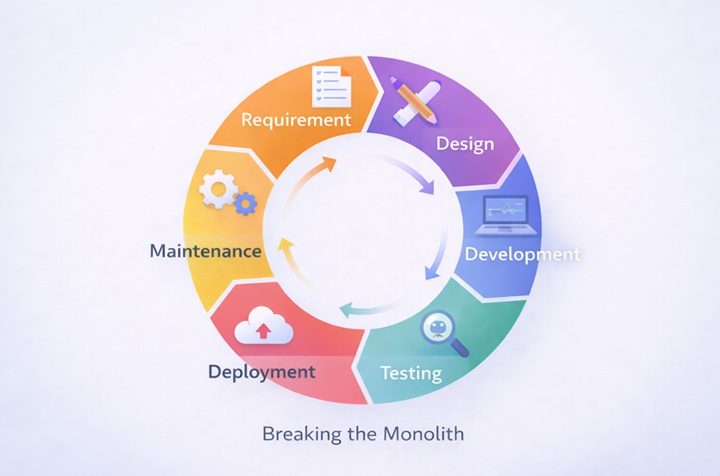
Phase 1: Requirement Analysis (The “What”)
This is the most critical phase. If you get this wrong, the whole project fails.
- Activity: The team talks to the client (Restaurant Owners/Users).
- Real World Example: “Users want a feature to track the delivery driver on a live map.”
- Output: SRS (Software Requirement Specification)
Phase 2: Design (The “How”)
Before writing code, we draw the blueprint.
- Activity: Architects decide which database to use (SQL vs NoSQL) and designers create the UI/UX wireframes.
- Real World Example: “We will use Google Maps API for tracking and MongoDB to store order history.”
- Output: Design Documents (High-Level & Low-Level Design).
Phase 3: Development (The Coding)
- Activity: Developers start writing the code. Front-end devs build the screens; Back-end devs build the logic.
- Real World Example: Writing the Java/Python code that calculates the delivery fee based on distance.
- Output: Source Code.
Phase 4: Testing (The Quality Check)
- Activity: QA (Quality Assurance) team tries to break the app. They check for bugs, security holes, and performance issues.
- Real World Example: “What happens if a user tries to order food with an expired credit card? Does the app crash or show an error message?”
- Output: Test Reports.
Phase 5: Deployment (The Launch)
- Activity: The code is moved from the developer’s laptop to the Production Server (Cloud/AWS).
- Real World Example: Uploading the app to the Google Play Store so you can download it.
- Output: Live Application.
Phase 6: Maintenance (The Updates)
The work isn’t done after launch.
- Activity: Fixing bugs reported by users and adding new features.
- Real World Example: “Users are complaining the app is slow on iPhones. We need to release an update to fix it.”
4. Popular SDLC Models
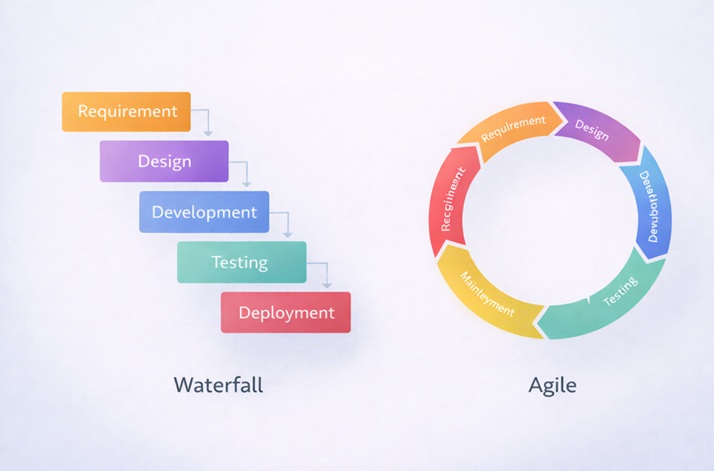
There isn’t just one way to follow SDLC. Here are the two main “styles”:
A. Waterfall Model (The Traditional Way)
- How it works: You finish Phase 1 completely before starting Phase 2. Like a waterfall, you cannot go back up.
- Pros: Simple and easy to manage.
- Cons: If you find a mistake in the “Testing” phase, you have to restart from the beginning. (Very risky).
B. Agile Model (The Modern Way)
- How it works: You build the software in small chunks called Sprints (usually 2 weeks). You release a small version, get feedback, and improve it.
- Pros: Flexible and customer-friendly.
- Cons: Requires constant communication.
5. SDLC vs. Agile: What's the Difference?
Feature | SDLC (Waterfall) | Agile |
Approach | Linear (Step-by-Step) | Iterative (Circular) |
Flexibility | Rigid (Hard to change) | Flexible (Welcomes change) |
Feedback | Only at the end | Continuous |
Best For | Construction, Manufacturing | Software, Startups |
6. How Does DevOps Fit In?
In the old days, SDLC was slow. DevOps automates the SDLC.
- CI (Continuous Integration) automates the Testing Phase.
- CD (Continuous Deployment) automates the Deployment Phase.
Trainer’s Insight:
“Think of SDLC as the Traffic Rules and DevOps as a Self-Driving Car. The rules (phases) are the same, but DevOps makes the journey much faster and safer.”